
Welcome to The Conscious Connection Blog. This is a space where we shift our mindset, step off autopilot, and begin parenting with awareness, presence, and compassion.
As a certified parent coach, I believe that parenting challenges are rarely just about behavior—they are about the underlying need for safety and connection. This journey is an opportunity to transform both you and your children: giving them the chance to feel deeply seen, heard, and valued, while offering us the chance to heal and evolve alongside them.
How Much Space Can You Hold for Your Child’s Discomfort?
This is the time of year when many of us start thinking about signing our children up for sports and after-school activities. Along with the excitement of a new season often comes the memory of previous experiences, especially those moments when something that was supposed to be enjoyable suddenly became difficult.
Perhaps you remember the struggle of getting your child to swimming class. The repeated refusal to get into the pool, the endless reasons that seemed to change from one week to the next: “The water is too cold.” “I already know how to swim.”
And somewhere in the middle of their resistance, you might find yourself thinking, But you asked me for this. You wanted to do it. I have already paid for the lessons.
And perhaps this is where the real question begins.
When our children are uncomfortable, our instinct is often to make a decision quickly. We either try to convince them to continue or, depending on the situation, remove the source of their discomfort altogether.
We might tend to solve the problem.
Perhaps the deep question is: How much space can I hold for my child’s discomfort? And what does their discomfort awaken in me?
Can I stay present without immediately trying to fix it, rush them towards a solution, or take the experience away from them
My own experience: When My Son Stopped Wanting to Go Swimming
Last semester, my son suddenly started refusing to go to his swimming lessons.
Every week, there seemed to be a different reason, and although I listened to each one, none of them felt like the whole story. It was not that I thought he was inventing excuses or trying to manipulate me. Quite the opposite. I had the feeling that his refusal was communicating something, but I had not yet understood what was underneath it.
I also had to recognise my own reaction.
I felt frustrated. I wanted to remind him that he had asked to do swimming in the first place. I had paid for the lessons and organised our schedule around them and, like many parents, I found myself wondering how much space I should give to his resistance.
At the same time, I could feel the weight of external judgment.
Was I being too accommodating? Was I allowing him to avoid something difficult? Or was I forcing him to continue when something about the experience was genuinely uncomfortable for him?
I also received unsolicited advice: “Simply take him to the lesson, allow him to cry if necessary, and trust that eventually he will find his own way.”
But something inside me was telling me that what he needed was not to be left alone with his discomfort. He needed support.
The first time he refused, we didn’t go.
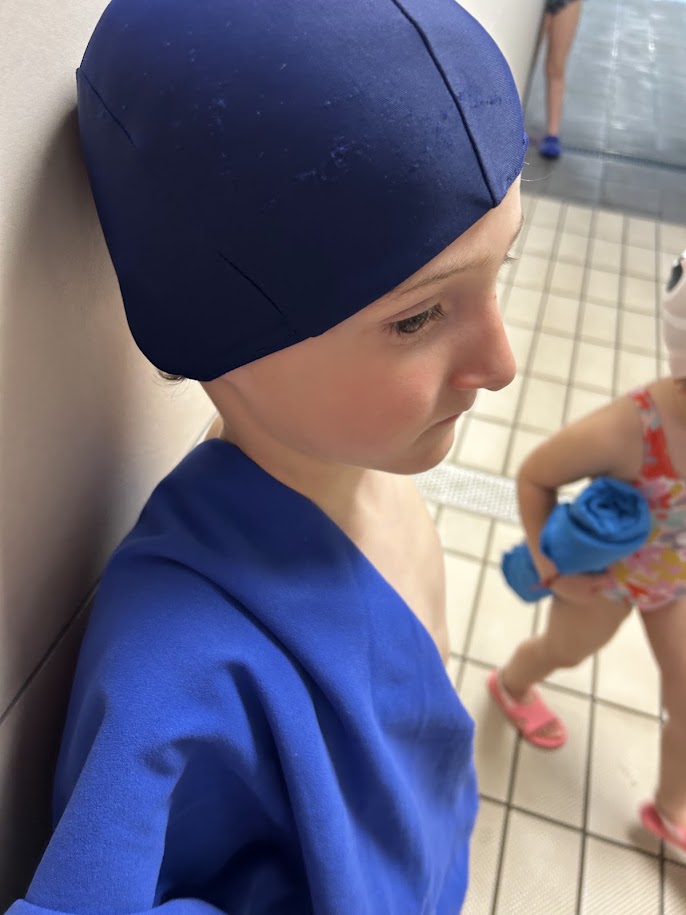
The second time, we went to the swimming pool and he put on his swimsuit, although very reluctantly. But when it was time to enter the pool, he couldn’t do it. So, instead of leaving or forcing him to join the class, we sat together on the bench and watched the other children.
We did this again for the following lessons. We showed up, he wore his swimsuit, and then we sat side by side, watching.
For three more sessions, that was all he could do.
And perhaps, from the outside, it might have looked as though nothing was happening.
But something was.
He was still connected to the experience. He was observing the other children and becoming familiar with the environment without being asked to do more than he was ready for. He was staying close to the very thing that had become uncomfortable, but he was not alone in it.
Then, during the fourth lesson, something changed.
He asked if we could go together into one of the free lanes. He didn’t want to join the class yet, but he wanted to swim alongside me while following what the other children were doing.
He still needed my presence.
So I was there.
The following week, he went back to the class by himself, and he completed the semester.
What Was Underneath the Refusal?
Looking back, I can see how easy it would have been to label his behaviour as clinginess or resistance.
When I allowed myself to pause and look a little deeper, I could see that he was navigating several layers of discomfort.
His swimming lessons were in Catalan. Growing up between three cultures, the language itself was a layer of unfamiliarity within an environment that already required him to separate from me, follow instructions, and trust a teacher.
There was also the discomfort of the context itself. Something that might appear simple from the outside can feel very different from the inside of a child’s experience.
Perhaps what he needed most was time to slowly build confidence—not confidence that could be given to him through reassurance alone, but confidence that could grow through experience.
This was not easy for me. I felt frustrated, questioned myself, and worried about whether I was supporting him or somehow making the situation more difficult.
But when I paused, I realised that there was another possibility.
I could accompany him through the process.
Discomfort Does Not Always Need to Be Fixed
As parents, watching our children struggle can be incredibly uncomfortable. Their distress often activates something inside us and, before we even realise it, we are looking for the fastest way to make the feeling disappear.
We reassure them. We convince them. We negotiate. We push. We distract. Or sometimes, we remove the situation completely.
None of these responses necessarily come from a wrong place. Most of the time, they come from love and from our desire to protect our children. But sometimes, our urgency to solve their discomfort prevents us from becoming curious about what it is actually communicating.
Discomfort is not always a sign that something is wrong. Sometimes, it is a sign that something is unfamiliar.
The question, then, is not whether our children should ever feel uncomfortable. They will.
The question is whether they have enough support to remain connected to themselves while they move through it.
In my son’s case, sitting on the bench was not about giving up on swimming, nor was it about making him participate before he was ready. It became a space in between—a space where he could remain connected to the experience without being overwhelmed by it.
From Discomfort to Acceptance to Growth
What I witnessed was not simply a child eventually deciding to go back to swimming. I witnessed a process.
He moved from discomfort towards familiarity, from familiarity towards acceptance, and from acceptance towards the confidence to participate again.
His confidence did not arrive before the experience. It grew through the experience.

What Does Your Child Need from You in Their Discomfort?
The next time your child tells you that they don’t want to continue an activity, perhaps pause before trying to convince them.
Before reminding them that they chose it, thinking about the money you have already spent, or deciding that they are simply being resistant, become curious.
What is underneath the discomfort?
And instead of immediately asking, How can I solve this?, perhaps ask yourself:
How can I support my child through this experience without taking the experience away from them?
Sometimes that support might mean stepping back. Sometimes it might mean giving them permission to stop. And sometimes, it might mean sitting beside them on the bench for as long as they need.
And perhaps, as we learn to hold space for our children, we also learn something about our own capacity to stay present with the uncomfortable moments of parenting.
If you would like support in navigating these moments with more awareness, connection, and confidence, I would love to hold space for you too.
Let’s grow—together. Book your free discovery session today.
